
I saw The Odyssey twice in four days.
The first time, I was simply trying to keep up. I went in almost blind. I knew the broad strokes. The Trojan Horse. The Cyclops. The Sirens. Zeus. What I didn’t realize was how all of those stories fit together into one epic narrative.
The second viewing completely changed the experience. Once I wasn’t focused on following the mythology, I was able to appreciate the filmmaking, the performances, and the emotional architecture Christopher Nolan built underneath the spectacle. The result was a film that became richer, more moving, and ultimately more satisfying.

Quick review: The Odyssey is a story about war, pride, consequence, family, and what it costs to find your way home. I love it! Go see it. See it on the biggest screen you can see it on! And if you can take it, cause it’s long, go more than once!
Spoilers Ahead.
The Hero’s Story?
Most people will tell you The Odyssey is about a hero battling monsters, outwitting mythical creatures, and surviving an epic quest to get home. It’s those things. But I also saw something else. I saw a story about the consequences of pride, entitlement, and the choices we make in pursuit of victory. Every obstacle Odysseus faces is tied, in some way, to decisions made by him or his men, and the journey becomes less about defeating monsters than confronting the cost of hubris, stupidity, or desperation. Beneath the spectacle is a deeply human story. This man trying to get back to his family and land. A father returning to the son he left behind, and a man searching not just for home, but for redemption after violence and war left him lost.

Matt Damon Anchors the Film
Matt Damon carries this enormous movie on his shoulders. He is well cast as Odysseus, bringing a realness, gravitas, warmth, intelligence, and quiet determination to a man who spends years traveling, fighting, strategizing, and searching for his way home to Ithaca. It’s a commanding performance. He feels trustworthy. You immediately understand why people follow him and why his family never stops believing he’ll return. His performance never feels showy. He allows everyone around him room to shine.
Damon is his most poignant when he is reunited with his long-lost family. When the fractured Odysseus is reunited with his wife (Ann Hathaway), the warrior, king, husband, and man become one again. When face to face with his son (Tom Holland), the movie’s emotional center comes fully into focus. These scenes are about a father leaving a baby and discovering a young man and a son standing beside the father he has spent his life imagining. That emotional homecoming gives the accompanying action its power. When it is time to reclaim his kingdom, Damon moves into another level of excellence. He becomes Jason Bourne, and I mean that as the highest compliment. He is precise, ferocious, and completely in command, but now every blow carries years of loss behind it.

Please, don’t get me started on the dog. That reunion absolutely broke me. In a movie filled with gods, monsters, battles, and spectacle, one old dog recognizing the man he waited years to see again may be its most devastating moment.
Growing and Poisoned Heart
Robert Pattinson is perfectly cast as Antinous, the ruthless leader of Penelope’s suitors.

He never asks the audience to like him, and he doesn’t soften the character with charm or irony. Instead, he fully embraces Antinous’s arrogance, cruelty, and sense of entitlement. Pattinson’s Antinous is sniveling. He is manipulative, calculating, and quietly terrifying, creating a villain whose confidence makes him even more dangerous. He commands every scene he’s in, and by the time Odysseus finally confronts him, the audience is more than ready for the reckoning. It is one of Pattinson’s finest performances and proof once again that he is one of the most fearless actors working today
Another nice surprise of the film for me was Tom Holland. Telemachus begins the story as a boy searching for a father he barely remembers. By the end, he’s become a man capable of standing beside him. Even though he still needs some fight training!
Samantha Morton is the one!
If I had to pick one performance that completely captivated me, it’s Samantha Morton as Circe. Her section of the movie was scary… and as the co-founder of a horror movie production company, I really perked up at these scenes!
It’s unsettling. Beautiful. Terrifying.

Odysseus’ sailors leave him behind and roll up to a home on a hill wildly desperate for food. Circe, expecting them, has set a clever trap. After an initial ‘don’t hurt me’ performance, she welcomes them with warm soup and mendacity. She serves a meal that transforms them into pigs… or really reveals their true selves.
Men filled with so much want. Gluttony. Violence. Lust.
The irony is that we’ve already watched these same soldiers sack cities, burn villages, and justify every action in the name of victory. We don’t actually know what they would have done had Circe simply fed them and left them alone.
When they first approached, they seemed to be just hungry and did not pose a threat. But… Would they have robbed her? Killed her? Destroyed everything she owned?
I was forced to ask the question because the film never answers it.
Odysseus ultimately threatens her ‘sister’ and negotiates to get his men back, and rather than destroying her, he asks for information that helps him get home.
It’s one of the smartest scenes Nolan has ever directed. The soldiers’ transformation back into their disguises as ‘men’ is equally trippy!
I would watch an entire movie about Circe.
A Story About Hubris
Watching it a second time, I thought this was a story about men convinced they deserve whatever lies beyond the next horizon.
Again and again, Odysseus and his crew create the disasters they later have to survive. They go towards victory and abundance directly into catastrophe.
One moment, in particular, struck me early in their travels home: they come to a land, desperate with hunger; they see a single sheep, but instead of feeding on it, they follow it, seeking an entire flock. Which leads them into the Cyclops’ cave. They had time to escape, but nope. They stay and wait for the cave’s owner. Oh boy.
The sequence suddenly becomes far more morally complicated than the myth usually suggests. Here are facts, from the Cyclops’ perspective: strangers have simply invaded his home.

The Sirens
The Sirens sequence is unforgettable. Odysseus tied to the mast while everyone else protects themselves from their song is incredible. The Sirens sing exactly what every person most desperately wants or needs to hear.
“It told you that what you most want is what you can’t have.
And what you most can’t have is what you already had, and lost” – The Siren Song in Nolan’s The Odyssey
They speak to regret. To grief. To the life you lost and can never recover. That idea lingered with me long after the film ended.
Moments Big, Small, and Moving.
The film’s scale is breathtaking. The coastlines. The environments.
The journey through Hades is haunting, and the conversations with the dead are powerful and visually breathtaking. Shout out to Elliot Page as Sinon. He ate!!
Every scene with the Trojan horse was mind-boggling, claustrophic, and visceral!

Odysseus talking to his queen about the violent sacking of Troy…Powerful. His return home is both emotional and exhilarating. The reunions with Penelope, with Telemachus …and with Argos, Odysseus’ loyal dog, completely broke me. That moment earned a tear.
The final act’s action never overwhelms the story. Instead, every confrontation carries the weight of twenty years of fury and longing.
STFU about CGI
People will undoubtedly talk a lot about the use of practical effects versus CGI in this film. I honestly don’t care. My only question is this:
Did the filmmaking pull me out of the story? For me, the answer was no. Never.
Let’s just let the filmmaker make his movie and crawl out of their process.
The Cast Beyond the Conversation
One of the things I appreciated most about The Odyssey was the ensemble cast. There has been far too much conversation about who “should” or “shouldn’t” play characters drawn from Greek mythology. Sitting in the theater, it simply never crossed my mind. The performances were so compelling that race disappeared, leaving only character.

Himesh Patel is exceptional as Eurylochus, bringing depth and quiet complexity to Odysseus’s trusted second-in-command. Zendaya is luminous in her dual role as Athena and the young Trojan priestess, giving the goddess an angelic presence that is both gentle and quietly powerful.

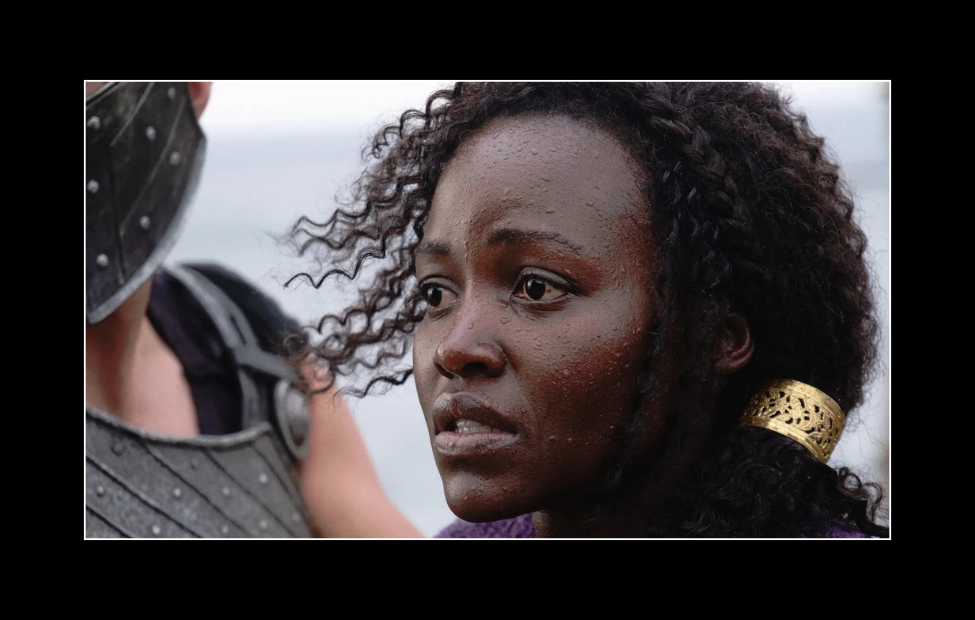
Lupita Nyong’o delivers a commanding performance as Helen of Troy and her twin sister, Clytemnestra, reminding us that talent and screen presence matter far more than preconceived ideas about who belongs in a myth. And then there’s John Leguizamo. As Eumaeus, he gives what I believe is the finest performance of his career. His portrayal of unwavering loyalty and quiet devotion is deeply moving, and in a film filled with gods, kings, and warriors, he reminds us that true greatness often belongs to the ordinary people who never stop believing.
Not once during the film did I think about the actors’ backgrounds. I thought about their characters. I thought about the story. That’s exactly what great casting is supposed to do.
These are mythological figures. They’re storytelling archetypes that have survived for thousands of years because the themes are universal.
What mattered to me wasn’t whether someone matched an ancient painting. What mattered was whether they made me believe.
Final Thoughts
Christopher Nolan adapted one of history’s greatest stories. He also reminds us why The Odyssey has endured for nearly three thousand years. Its complex emotional depth. This film takes that and matches it with brilliant performances and craftsmanship. It’s all reasons to see this movie.
Is The Odyssey Christopher Nolan’s greatest journey?
I don’t know… but it may be his most human. Beneath the gods, monsters, battles, and breathtaking spectacle is a story about a father, a husband, and a person lost trying to find their way home. It’s a film that rewards patience, asks big questions, and lingers long after the credits roll. The Odyssey is a journey worth taking.