
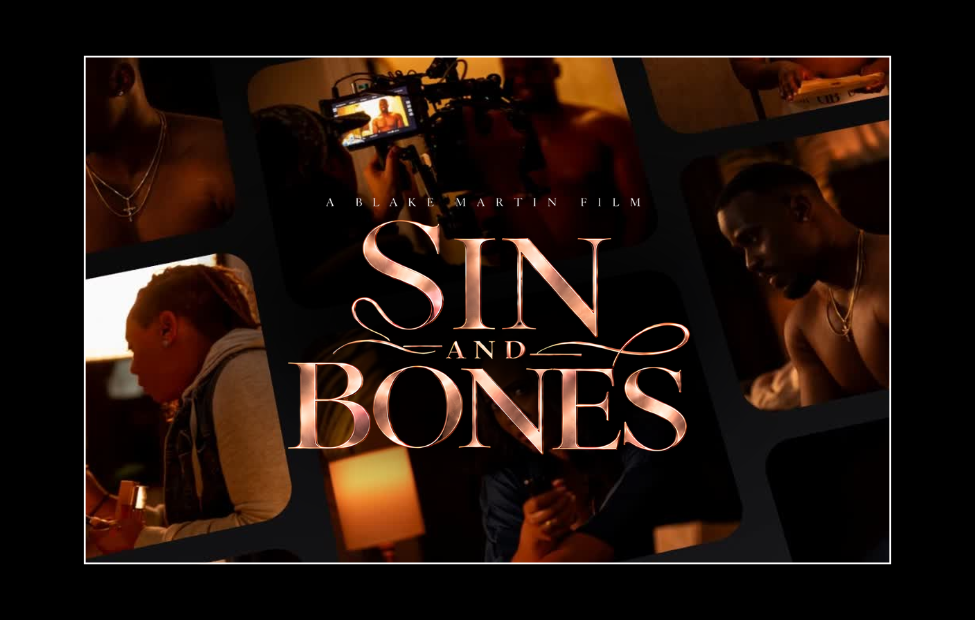
With nearly 50 cast and crew members, private investment and a production that mirrored the studio system, the Chicago writer-director completes his largest short film yet—and discovers that the story he set out to tell isn’t quite the one he ended up making.
What do you get when you combine a complicated love affair, a filmmaker determined to turn Hollywood’s obsession with female nudity on its head, nearly 50 cast and crew members, and an independent production with ambitions that far exceed its resources? Apparently, you get Sin and Bones, the latest film from Chicago writer-director Blake Martin. A provocative exploration of sex, power, class and the dangerous business of wanting more from someone who has already told you no.
At the heart of the film is a relationship in which two people have agreed to the same arrangement but somehow ended up playing by entirely different rules. It’s messy, sensual, emotionally complicated and, at times, painfully familiar. But Martin’s ambition extended beyond the screenplay. He was attempting to build the kind of production capable of telling the story exactly as he envisioned, even when the resources suggested he should scale back.

I had the opportunity to visit the production, and what I encountered was far more ambitious than its independent status suggested. Camera crews, lighting technicians, intimacy coordinators, security, producers and production assistants moved through the set with the precision of a much larger operation. Nearly 50 people had assembled to make a film about two people who couldn’t quite figure out what they meant to each other. And somewhere in the middle of that beautifully organized chaos was Martin, directing his biggest project yet while learning something about leadership and the art of letting other people help bring your vision to life.

DeVon Thomas plays Saint, a 28-year-old mechanic who has fallen in love with Brooke, a successful 40-year-old music executive portrayed by Nolita Pore. Their relationship began with clearly established boundaries: sex once a week, nothing more. But nearly a year of intimacy has left Saint wanting the one thing Brooke never promised him: love. The film asks a deceptively simple question: Can two people experience the same relationship and walk away with entirely different understandings of what it meant?

For Martin, the story began with a question: What happens when two people who seemingly have no business being together end up in the same bed? “What happens when Tyra Banks decides to date the Walmart cashier? Or Beyoncé falls for a middle school teacher?” Martin explained. “And her power isn’t intimidating, and his normalcy isn’t something to pity. Neither person needs saving. They’re just two people looking for the same thing in wildly different ways.” It was that collision of worlds, rather than the differences themselves, that fascinated him. What happens when attraction brings two people together, but their expectations of love threaten to pull them apart?
The premise also grew from a recurring theme throughout Martin’s work: “See me.” Saint wanted to be seen by a woman he admired, a woman whose world represented everything he had never experienced. Brooke, on the other hand, wanted no part of the emotional attachment Saint was developing. She had established the terms of their arrangement and expected him to honor them. But as the screenplay evolved, Martin began discovering something beneath Brooke’s insistence on maintaining control. “Somewhere in the writing, she began to want that from him too. She just doesn’t realize it.”

One line in the screenplay captures that imbalance more effectively than almost anything else. During a confrontation, Saint tells Brooke, “You wanted something from me—dick. I wanted something from you—access. I gave you good dick and you just…fucking forgot.” It was my favorite line in the entire script, and hearing it delivered from another room on set gave me chills. In a few brutally direct sentences, Martin exposes the unspoken transaction at the center of their relationship. Brooke believed she was negotiating sex. Saint believed he was negotiating entry into her life. Somewhere between those expectations, both convinced themselves the other understood the agreement.
That complexity deepened during rehearsals, where both actors discovered dimensions of their characters that even Martin had not anticipated. Pore approached Brooke as a woman whose carefully constructed boundaries conceal a complicated emotional life. “Brooke knows that she wants something more,” she explained. “She wants something that makes her feel something, something that belongs to her, but she struggles with being honest enough, and vulnerable enough, to really explore what that ‘something more’ should look like.”
Thomas prepared by creating a journal documenting Saint’s imagined memories before the screenplay begins. Through that process, he discovered a young man whose desire to be loved had become inseparable from his need to feel useful. “He’s become so accustomed to showing up for other people, Brooke and everyone else who crosses his path, that somewhere along the way, he forgot how to show up for himself,” Thomas said.
Saint sees their intimacy as evidence of a relationship. Brooke experiences many of those same moments but remains determined to control what they mean. Neither character is necessarily dishonest, and neither is entirely innocent. “Sometimes nobody has to be the villain,” Thomas observed. “Two people can genuinely care about each other and still hurt each other because they are operating from two different emotional realities.”
For Martin, the actors’ discoveries challenged his own understanding of the material. “DeVon brought a softness to Saint that made you want to care about him,” he said. “He made you fall in love with Saint. He made you want to root for him.” Pore’s interpretation proved equally transformative. “Nolita made Brooke a person,” Martin explained, crediting her with introducing competing desires that made the character more emotionally complex.
By the time production wrapped, his interpretation had shifted. “The original film was about sex, and class, and desire,” Martin said. “But what we made? It ended up being a film about boundaries, and communication, and how we protect ourselves from and with love.”
That evolution was the product of an unusually intentional rehearsal process. Pore spent weeks exploring Brooke’s history and relationships, even incorporating elements of the character’s imagined lifestyle into her daily routine. Thomas similarly credited Martin with encouraging him to investigate what existed beneath the dialogue.

“He wanted to walk through the process with me instead of simply telling me who Brooke was supposed to be,” Pore said. Thomas recalled moments when a simple question from Martin changed his interpretation of a scene. “He knew what he wanted, but he still gave me the freedom to bring my own instincts to the character.”
Watching Martin work, the change in his approach to directing was evident. He rarely remained behind the monitor for long after a take, frequently approaching the actors to discuss motivation or explore different choices. It is a skill he has consciously developed over the two years since he began directing films. Early in that journey, Martin believed that once actors arrived on set, his responsibility was largely to let them work without interference.

“When I first started, I thought, ‘Once we are on set, leave them actors alone. They have a job to do,’” Martin recalled. That perspective changed after actress and mentor Cynthia Kaye McWilliams explained that actors welcome direction and notes. Over time, Martin began embracing the conversations, probing questions and creative exchanges that have since become central to his directing process.
“I loved when I would see something change in their eyes and they got the story even more, even deeper, in real time,” he said.
The actors’ willingness to become vulnerable reflected the larger culture Martin wanted to establish: preparation, communication and respect. Pore, initially apprehensive about filming intimate scenes, credited Thomas with helping her feel safe enough to explore the material. Thomas described his own challenge as surrendering the instinct to protect himself emotionally and physically while portraying Saint.
Building that environment required considerably more resources than Martin had previously managed. At a little over $10,000, Sin and Bones represents his largest short-film production to date. His previous three shorts cost approximately $1,800, $2,300 and $3,000, respectively. The increased budget brought a larger crew, out-of-state talent, multiple filming days and new logistical responsibilities.
Of the three roles Martin occupied as writer, director and producer, producing proved the most challenging. The production was nearly derailed when the hotel around which the screenplay had been written became unavailable just weeks before filming. Martin had to rework the script around a different location. Crew availability shifted, schedules changed and unexpected expenses accumulated.
“So many things went wrong. SO MANY THINGS,” Martin recalled. Rather than treating those setbacks as reasons to retreat, he viewed them as preparation for the greater responsibilities of larger productions.
There were also creative compromises he refused to make. With roughly 28 pages of dialogue scheduled across two principal filming days, Martin was encouraged to reduce the screenplay significantly. He declined. “I really believed in the story and my actors, so I wanted to make it happen,” he said. “My ambition is always bigger than my brain, always.”
The schedule required Thomas and Pore to film nearly 20 pages of dialogue in a single day. Both credited their preparation with allowing them to focus on performance rather than the clock. For Pore, the production’s organization made an equally important difference. “There was a level of care that I had not experienced in quite the same way on previous productions,” she said. “People showed up prepared, things moved with intention, and there wasn’t chaos bleeding into the atmosphere.”
That observation speaks to a significant development in Martin’s career: he had assembled a team that allowed him to concentrate primarily on directing. Producer Amanda Ballard carried substantial production responsibilities alongside him, while First Assistant Director LaTaryion Perry, who previously collaborated with Martin on Messy Lola, managed the floor. Lead Production Assistant Aubree Bravo supervised a sizable PA team, keeping the operation moving while Martin remained with his actors.
And this is where the scale of Sin and Bones becomes particularly interesting. With a budget of just over $10,000, the production operated in ways that closely resembled the studio system. There were defined departments, a clear chain of command, detailed call sheets, dedicated production leadership, security, intimacy coordination, and a division of responsibilities that allowed each department to function independently. Walking through the set, it was easy to forget that this was an independently financed short film. The infrastructure and professionalism suggested a production working with considerably greater resources.
For Martin, that structure meant he could finally spend his time doing what a director is supposed to do: direct. He could remain at the monitor, give notes and make creative decisions without repeatedly leaving to solve logistical problems. The resources were modest by industry standards, but the expectations were not.
Martin was equally intentional about the film’s fashion and visual identity. Determined to make the contrast between Saint and Brooke’s worlds feel as striking as their relationship, he incorporated luxury fashion into the production, with approximately 85 percent of the film’s wardrobe supplied by German luxury fashion house MCM. Additional pieces came from Debonair Men, Christian Louboutin and Tom Ford. The production also incorporated rented Rolls-Royce vehicles, Rolex accessories and, as Martin readily acknowledges, “a crap ton of stuff from Amazon.” The combination was deliberate. Brooke’s world needed to communicate wealth and influence without making Saint’s more modest existence feel inferior. For Martin, luxury wasn’t simply about expensive labels; it was another way of telling the story, allowing fashion, cars and carefully chosen details to establish the distance between two people who somehow found themselves sharing the same bed.
The film’s intimate material particularly benefited from that structure. Martin initially struggled with writing the central sex scene, despite its limited dialogue, and considered removing it. Eventually, he concluded that avoiding the physical dimension of Saint and Brooke’s relationship would undermine the story. He also wanted to challenge a familiar cinematic convention: the expectation that women should carry the burden of physical exposure in stories about sex.
“So often in movies like this, people lean on the woman to be nude, and show her butt and breasts and carry the load of being vulnerable,” Martin said. “Well, let’s flip that on its head and give the ladies a rest from that — and give our female audience something amazing to look at. Strip him down!” he added with a laugh.
But behind the humor was a serious commitment to the performer being asked to take that risk. Thomas was required to be completely nude on set for the sequence, a level of physical exposure that demands considerable courage, regardless of an actor’s experience. Martin was particularly mindful of that responsibility. Extensive conversations and preparation with intimacy coordinators Jazmin Johnson and Aubree Bravo helped establish expectations, boundaries and an environment in which Thomas could feel safe and supported.
It is worth recognizing what Thomas contributed in that moment. Standing completely exposed in front of a production crew is no small undertaking. His willingness to do so reflected both his commitment to the character and the care taken by the production to ensure he was never navigating that experience alone. The sequence was conceived not as spectacle, but as an extension of Saint’s emotional vulnerability.
For the film’s executive producers, witnessing the production offered a different perspective on what their financial support had made possible.
Travis Starks, founder of independent luxury maison T STARKS, found the experience particularly meaningful. “Being on set made the commitment feel tangible,” Starks said. “When I first became involved, I was thinking about what the film could become. Being there brought my attention to the people responsible for bringing it to life.”
For Starks, the experience reinforced the importance of collaboration. “The biggest takeaway was how much a creative vision depends on collective effort. Every contribution matters to what ultimately reaches the audience.”
Fellow Executive Producer Paris Ashford shared that appreciation, describing the experience of watching a screenplay transform into a working production as both exciting and rewarding.
“It’s one thing to believe in a vision on paper, but seeing the cast, crew, and creative team bring it to life was something entirely different,” Ashford said. “It gave me a deeper appreciation for the passion, talent, and collaboration that goes into filmmaking.”
What impressed Ashford most was the sheer complexity of the operation. The finished film may appear seamless to audiences, but standing on set revealed the number of moving parts required to create that illusion.
“It was fascinating to see how much work happens behind the scenes to create what audiences will ultimately experience as a seamless story,” Ashford explained. “Every department contributes something essential, and seeing those contributions come together was impressive.”
For both executive producers, the investment represented more than financing a single project. It was an opportunity to support a filmmaker and the creative community surrounding his work.
“I’m most proud of helping turn a creative vision into something real,” Ashford said. “Investing in Sin and Bones was about more than supporting a film; it was about believing in the story, the people behind it, and the opportunity to create something meaningful. Seeing it all come together made that investment worthwhile.”
Martin remains candid about the gratitude and pressure that accompany private investment. “To have anyone believe in me enough to share their money is so humbling,” he said. “But it also came with pressure. Will they think the project was worth it? Do a good job so they will invest again in the future. I want to make them proud.”
That appreciation extends well beyond the film’s investors. Martin is particularly emphatic about the contributions of his cast and crew, many of whom were asked to accomplish an extraordinary amount of work within an unforgiving schedule. From the actors carrying pages of emotionally demanding dialogue to the technicians executing complex setups and the production team navigating last-minute challenges, he credits their commitment with making the film possible.
“We did the unthinkable,” Martin said, reflecting on the production. “I am so grateful to my cast and crew for going above and beyond. Every single department gave more than I could have asked for, and I don’t take that lightly. We accomplished something that, on paper, probably shouldn’t have been possible. And we did it together.”
That sense of responsibility extended to the broader creative community. Martin welcomed aspiring filmmakers who wanted to observe production. Still considering himself an aspiring director, he understands the significance of access to working sets. Rather than positioning himself as someone with all the answers, he offered visitors an opportunity to watch departments collaborate, observe actors receiving direction and experience filmmaking firsthand.
Several visitors and crew members described the production as something refreshing within Chicago’s independent filmmaking community. The city has a rich cinematic history, and Martin makes no claim to having invented professional independent production. What distinguished this experience was the effort to bring experienced professionals, emerging artists, investors and aspiring filmmakers into the same environment.
And yet, perhaps the most important development on Sin and Bones was personal.
Martin arrived on set more confident than he had been on any previous production. The logistical problems had not disappeared, nor had the pressure of leading a larger team. But he no longer interpreted every challenge as evidence that he was unprepared. Difficult conversations with collaborators required him to establish expectations and make uncomfortable decisions. Those experiences, he believes, made him a stronger leader.
“I am hands down a better leader after this,” he said.
Thomas experienced a parallel transformation. Despite his experience as both an actor and filmmaker, he admitted struggling with self-doubt during preparation, questioning whether he could fully realize Saint’s complexity. Martin repeatedly reassured him that he had been cast for a reason.
“At a certain point, I had to stop questioning whether I belonged in the role and just trust the work I had already done,” Thomas said.
It is a revealing connection between actor and director: two artists discovering that preparation can only take them so far. Eventually, they have to believe they belong in the room.
For Martin, that realization was especially significant. “I walked into Sin and Bones thinking I needed to prove my vision was worth the care,” he said. “I walked away realizing that’s not a point I need to prove.”
There were moments during filming that reinforced that confidence. Martin recalled watching shots he had imagined weeks earlier finally appear on the monitor, uncertain until that moment whether the production could execute them. When the images materialized, the reaction was immediate. “There were a few scenes that I saw in my head weeks before filming and I just didn’t know if I would get them,” he said. “And I did.”
Those moments offered something beyond the satisfaction of completing an ambitious production. They suggested that the filmmaker’s imagination, the actors’ interpretations and the crew’s technical expertise were working in concert.
That collaboration ultimately mirrors the film itself, though in a very different way. Saint and Brooke struggle to communicate what they need from one another. Saint wants to be seen. Brooke wants to be understood without surrendering control. Both search for connection while protecting themselves from what that connection might demand.
Behind the camera, nearly 50 people demonstrated what becomes possible when individual contributions are given room to flourish. Actors brought new dimensions to the screenplay. Department heads translated ambitious ideas into practical execution. Producers created the structure necessary for the creative work to happen. And an emerging director began recognizing that leadership is not about personally carrying every responsibility.
Pore hopes audiences recognize the difference between protecting themselves and preventing themselves from experiencing what they desire. “Sometimes we become so committed to maintaining control that we never allow ourselves to experience the very things we say we want,” she said.
Thomas hopes viewers consider how easily love can become an exercise in self-abandonment, particularly when someone begins measuring their worth by how much another person needs them. Neither actor wants an easy verdict about Saint and Brooke. Martin doesn’t either. He wants disagreement, conversation and audiences who recognize something of themselves in characters whose choices they may not always support.
Now heading into post-production, Sin and Bones represents Martin’s most ambitious short film to date. For three days in Chicago, he and his collaborators built the kind of filmmaking environment he once hoped to be invited into. This time, he was responsible for creating it, and he made room for others to experience it alongside him.
There is something fitting about a film concerned with the desire to be seen becoming a production in which so many people felt their contributions mattered. Perhaps that is the real story of Sin and Bones: not simply that an emerging filmmaker assembled the resources to make a larger movie, but that he learned the value of allowing other people to help make it better than he could have imagined alone.

And judging by what appeared on the monitor, audiences may soon have a compelling new reason to pay attention to Blake Martin.